
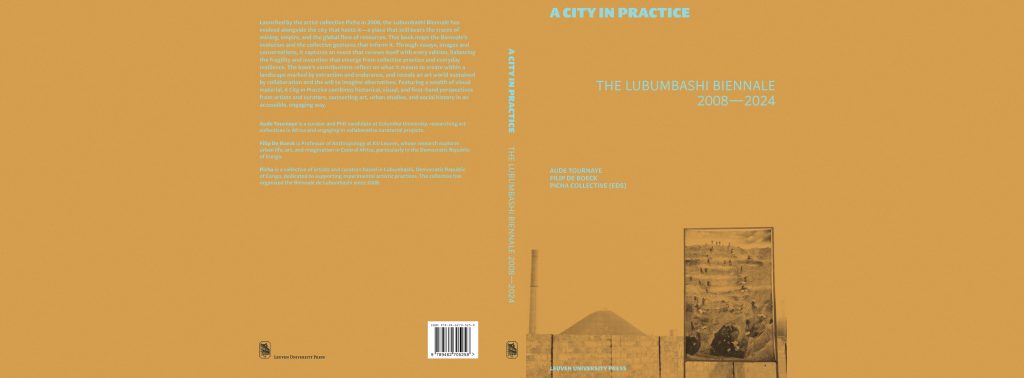
- Editors: Audé Tournaye, Filip De Boeck, Picha Collective
- Contributors: Lotte Arndt, Sandrine Colard, Daniela Géo, Kim Gurney, Bogumil Jewsiewicki, Toma Muteba Lutumbue, Simon Njami, Joseph Tonda
- Publisher: Leuven University Press
- Publishing date: 15 September 2026
- Available (paperback, epub and open access pdf): https://lup.be/book/a-city-in-practice/
- DOI: 10.11116/9789461667908
Kim Gurney, Senior Researcher at the CHR, is a contributing author for the first comprehensive publication on the Lubumbashi Biennale, a newly released book that traces relations between the city, its growing art scene and collective practice.
A City in Practice: The Lubumbashi Biennale (2008-2024) is edited by Audé Tournaye, Filip De Boeck & Picha Collective. Other contributing authors include curator Simon Njami, as well as curator and academic Sandrine Colard, who last year was an invited guest at CHR for an international Visual History & Theory workshop. Gurney and Colard have also previously appeared together on a public forum at University of Leuven speaking about art, public space and cities of the South.
Gurney’s chapter, titled ‘Platform/ Plotform: On doing things with art’, is about institution building as artistic practice – how independent art spaces in fast-changing cities in Africa shapeshift to navigate uncertainty and flux. The chapter places Biennale de Lubumbashi and its organising collective Picha in a broader continental kinship of artist-anchored spaces that, despite operating in singular contexts, have some key working principles in common.
Leuven University Press states: “Launched by the artist collective Picha in 2008, the Lubumbashi Biennale has evolved alongside the city that hosts it—a place that still bears the traces of mining, empire and the global flow of resources. A City in Practice maps the Biennale’s evolution and the collective gestures that inform it. Through essays, images and conversations, it captures an event that renews itself with every edition, balancing the fragility and invention that emerge from collective practice and everyday resilience. The book’s contributions reflect on what it means to create within a landscape marked by extraction and endurance, and reveals an art world sustained by collaboration and the will to imagine alternatives. Featuring a wealth of visual material, A City in Practice combines historical, visual, and first-hand perspectives from artists and curators, connecting art, urban studies, and social history in an accessible, engaging way.”