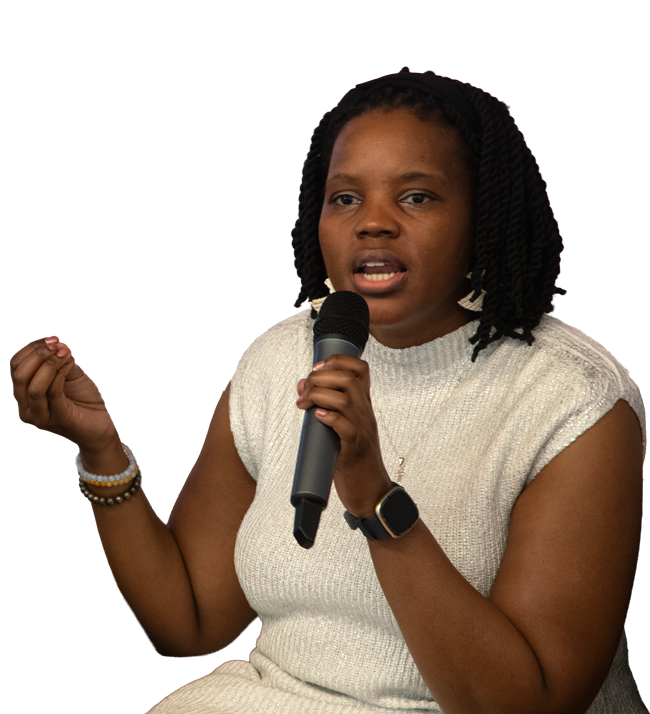
It seems unthinkable to be sharing a tribute for Tiisetso Dladla who passed away in Johannesburg on 11 August 2026. We are shocked and heartbroken at UWC where Tiisetso was a doctoral fellow of the New Archival Visions (NAV) at the Centre for Humanities Research, with her PhD registered in the Department of Historical Studies.
Initially introduced to the CHR by former UWC DVC Professor Pamela Dube in 2020, Tiisetso was in conversation with the late Jane Taylor to pursue her doctoral studies at UWC. Tiisetso joined the NAV programme attached to an archival revitalisation process at UWC which is a joint custodian of the Mayibuye Archives, one of the country’s liberation archives. The programme is committed to activating the university’s archival collections bringing in dynamic young scholars and talented artists tasked with bringing history alive and drawing attention to it, creating something of a public surprise. Working with supervisors Heidi Grunebaum and Patricia Hayes on her doctoral project, Tiisetso embraced the serious and edgy ethos of the programme. In her doctoral thesis and planned film, Tiisetso was investigating the capacity of immersive media technologies in documentary filmmaking to function as “immersive time capsules”, bringing the past to wider, younger audiences in contemporary public and cultural spaces. She turned to the 19th century novel form and to changes in 20th century conventions of portraiture in painting and photography to think about the narrative and visual dimensions of her project. She herself was a painter. Tiisetso’s preliminary analytical work on how conventional documentary film footage in a liberation archive can be marked by distance, condescension, and outsiderness in relation to the lives of most black South Africans, shows how far these archival collections are from liberation and its claims, and how urgent was the creative task of exploring new frontiers and creating new kinds of images that bring us closer – even if only in our imaginations – to what is historically authentic and important.
A brilliant thinker and filmmaker, Tiisetso was also an artist, technologist and university lecturer. She completed a degree in Journalism from Howard University and a Masters degree in Cinema from Tisch School of the Arts, NYU. Invited to work in Spike Lee’s production company, Tiisetso deepened her ideas about cinema and developed important archival and research skills. A Pan-Africanist and a tender, courageous thinker of black life through a trans-Atlantic lense, Tiisetso was committed to contributing her remarkable talents to shaping the minds of a younger generation of film and media makers in South Africa. Having been Art Director for Spike Lee’s Da Sweet Blood of Jesus, and despite the serious opportunity extended to her in New York to advance her career, Tiisetso returned to South Africa to take up a teaching post at Wits University.
Tiisetso was interested in history, and was remarkably sensitive to the overlooked, marginalised aspects of the past. As a scholar, artist and teacher, she was also strikingly future-oriented. Each winter, Tiisetso would visit Cape Town for archival research and to participate in the annual workshops in Visual History & Theory as well as the CHR’s yearly Winter Schools where she would ask the most provocative and sharp questions. Her rich laughter of enjoyment, and sometimes irony, warmed us all and she radiated a kind of luminous shine. Tiisetso’s unique presentations were intellectually exciting and they challenged all of us to think more seriously about the implications of immersive media. From our initial scepticism of the new media technology, Tiisetso brought us to a more precise appreciation of its singularities and potential, thanks to her role in bringing ground-breaking 3D work to the attention of a younger generation of students and young filmmakers in South Africa.
As she experimented with the medium and new camera technology in her own immersive film practice, Tiisetso took pains to emphasise the ways that the 360 degree camera means that the viewer is not outside the frame and this represents a break with previous understandings of photography and cinema, arguing that immersive technology is not burdened by histories of the colonial gaze but rather represents entirely new frontiers for young black filmmakers and artists. Tiisetso drew attention to the technical vocabulary of immersive technology and how footage filmed with the 360 degree camera is “stitched” rather than “cut” in the edit. Because VR films place the viewer inside the image – the camera is replaced by the body – they do not allow for the flattening distance of the colonial gaze. The viewer no longer looks at a sacred site, for example, but inhabits it. For Tiisetso, this technical observation was the beginning of an ethical demand which she called “immersive attunement”, a practice of self-awareness and editing so rigorous that it begins before the camera shutter opens or the drone lifts off. She elaborated this argument in her recently published article, entitled “Immersive Attunement: Consciously Capturing Cultural Geo-Heritage Sites in Cinematic Virtual Reality”. Her scholarship and filmmaking were a sustained argument against extraction. For this reason, and having mastered the form, Tiisetso advocated for the ground breaking possibilities that immersive technologies offer African artists.
Tiisetso sparkled with big ideas and worldly projects that connected images, people, places and pasts within and beyond these shores. She pursued them with immense courage and integrity, and a big heartedness for which she has been so deeply cherished. We are pained to think what the shock of this loss means for Tiisetso’s mother, Dr. Yvonne Dladla, her beloved son and her family. We are also profoundly pained to think what her passing means for the bigger project of breaking free of colonial and apartheid ways of being and seeing in this country. Tiisetso was the bridge connecting a new generation with what was vital about a past generation that has been muffled and forgotten. This was a living ethos for her and she always had a camera with her. It is up to us all, colleagues, students, friends, to learn from her life and work and to take it further. In 2025, Tiisetso presented a paper at the Visual History and Theory workshop entitled, “Gesture of the Soil: Meditation on the Hand of Sobukwe”. A bright, brilliant shooting star, our beloved Tiisetso, this daughter of the soil is now returned to its eternal embrace. We will remember and celebrate Tiisetso and all she continues to give beyond the gift of grace that she offered to all who encountered her.