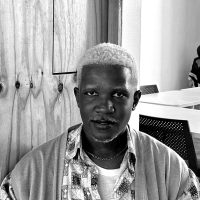
Katlego Tiisetso Nkoana
New Archival Visions Honours Fellow
Katlego Tiisetso Nkoana is a BA Honours History student whose work refuses to let the past stay silent on a page. He studies history not only as a sequence of dates and documents, but as a living texture of sounds, smells, textures, and silences that conventional archives often leave out. Alongside his academic training, Katlego is a poet and musician. His poetry compresses complex ideas into rhythm and image, while his music carries the cadence of storytelling into performance spaces. For him, verse and melody are not separate from research. They are tools for making historical narratives more immediate, more felt, and more accessible to people outside the academy. Katlego has practical experience curating public history. He worked with the Centre for Humanities Research as an assistant curator for the Augmented Reality exhibition _Facts and Fabulations_. In that role he helped design immersive, digital layers that brought archival material off the wall and into the visitor’s environment. The project pushed him to think beyond glass cases and wall text, toward experiences where audiences could encounter history spatially and interactively. His research interests are rooted in the sensorium and what he calls “sensory vacuums” in academic research. He critiques ocularcentric modes of knowledge production, the overreliance on sight and text and explores how touch, sound, scent, and embodied experience can expand how we know and share the past. He seeks toexplore how exhibitions and archives might be reimagined so that knowledge is not only read, but also heard, felt, and moved through.
Katlego hopes to make exhibitions and archives more accessible through innovative sensory modes. His goal is to build encounters with history that welcome blind and low-vision visitors, neurodiverse audiences, and anyone who learns differently. By combining critical historical scholarship with poetic language, music, and AR design, he is working toward archives that do not just preserve the past, but invite people into it.